Wednesday, February 11, 2015

“Wild” Debates On The PCT (Part Two): Caches

The Pacific Crest Trail is a National Scenic Trail that stretches approximately 2,650 miles from Mexico to Canada through California, the State of Jefferson, Oregon, and Washington.  In the recent past, every year saw a couple of hundred “thru-hikers” attempt to hike the entire trail in one hiking season.  But due to the recent success of the book and movie “Wild,” many in the trail community have expressed fears that the trail will become overcrowded with people who aren’t “real hikers.”
This author doesn’t understand how imaginary hikers could possibly cause much impact (or any impact at all), but the impact is definitely there, mainly in the form of intense debates around aspects of trail life that formerly provided us with little to no drama over the winter.

Part One of this series focused on hikers carrying large pieces of furniture on the PCT.  In Part Two of this series, we look at another suddenly controversial feature of the Pacific Crest Trail: caches of office supplies.


A hiker relaxes at Third Hole Cache
The time is spring, 2008.  The place is the PCT in Southern California.  I roll up to Third Hole Cache, open a box, select a three-hole punch, and add it to my supplies.  After writing a short “thank you” in the register (and hole punching the crap out of it), I hike on towards Barrel Springs.

Not too long ago, this was an unremarkable event on the trail.  People who provided caches of office supplies were viewed by many as trail heroes, their efforts and altruism appreciated.  Recently, however, the need for (and existence of) office supply caches has been called into question as hiking the PCT rises in popularity.

“It’s completely unnecessary,”  says Wylie “Crazyhorse” Jones.  “Hikers should be self-sufficient.  They should be carrying all of the office supplies they need, not relying on caches for paper clips and staplers and desk blotters.  But with caches out there, they do.”

The Scissors Cache has long been a source of debate,
mainly because of fears that trail runners might
carry them.


Others disagree.  According to Rachel “DurrdayFeet” Abrams, “I don’t rely on caches, but lets say I break my scissors and I need to cut my hair or do some scrapbooking or trim some filo pastry for a nice baklava?  A cache of scissors can be a godsend.  Maybe only for hirsute artsy-crafty Greeks, but still.”

Some blame the reliance on office supply caches on the emergence of lightweight gear and the hiking mindset that surrounds it.  “There was a time when hikers with 50 or 60 pound packs carried all of the office supplies they needed,” says Junaid “Speshul” Dawud, “people were prepared to travel 30 or 40 miles without counting on someone else for highlighters, Post-Its, and toner cartridges.  Today?  If the question is ‘how many three-ring binders is someone really going to carry in a ULA Circuit,’ then ‘not enough’ is the answer.”
But even that perspective is open to debate.  “The thing is,” says Namie “LetItBe” Bacile, “every small town along the trail used to have a small stationary store or something, until the big box stores put them out of business.  The Saufleys used to loan out a Chevy Suburban for supply runs to an Office Max in L.A., but they stopped doing that years ago.  Today, if you need a ream of laser printer paper?  Good luck.  Unless you hit a cache.”


One way or another,  the Swarthout Canyon Office Depot cache
may become a thing of the past.
Ultimately, says Kathryn “A-Dubs” Nicole, while caches are appreciated its the combination of numbers and reliance that creates a dangerous situation.  “It’s a safety issue.  If you’re counting on caches for basic necessities like scotch tape, Sharpies, and tri-fold poster board, what do you do if there are forty hikers ahead of you and they’ve decided to have an on-trail science fair?  You’re screwed.”

For now, the future of caches is unclear, but the problem may just resolve itself.  The resources of the people who fill office supply caches are being increasingly taxed, and some may back away from helping hikers in this way.  And as once-dependable caches full of rubber bands and dry erase board cleaner are emptied by large bubbles of hikers, the caches may come to be viewed as increasingly untrustworthy sources, thus reducing reliance.

But until then, one thing is clear: office supply caches will remain a subject of debate for people sitting behind computer screens who would rather be out hiking.


Note: Thank you to the hikers who allowed me to fake quote them for this article!

Saturday, January 31, 2015

Appalachian Trail Thru-Hiker Situational Training

As someone who has successfully completed thru-hikes, I’ve occasionally been asked about my pre-hike training routine.  As a contributor to Yogi’s PCT Handbook, I described my PCT training  like this:
I watched “Jeremiah Johnson” and “Lawrence Of Arabia” and I read a book about the Donner Party called “Desperate Passage.”

. . . but until you start, maybe stay on that couch.


When asked what I would do differently next time, I said I would get “Desperate Passage” in paperback instead of hardcover.

So I’m not that into pre-trail physical training.  Why?  I’ve come to believe that the best and most efficient exercise for hiking the trail is actually hiking on the trail.  So I could spend two months physically training for a five month hike.  Or I could spend the first month of that hike physically training for the other four.  Will that first month hurt more than it will for someone who’s been exercising for two months?  Possibly.  Because they spent the previous two months in pain, while I spent them on the couch blissfully eating Funyuns.  I’m pretty sure I win that round.

Now, if I had to hit the ground running?  If I was attempting a speed record, or had to be in school by the middle of August, or someone was paying me by the mile?  Yeah, absolutely, pre-trail physical training makes sense.  But for most people, there really isn’t any sort of necessary rigorous schedule at the beginning of an AT hike.  There aren’t 150-mile stretches without resupply.  No 35-mile stretches with no water.  No one coming up from behind and killing the slow people just for being slow.
People who are used to the rat race sometimes have a hard time listening to their bodies and adjusting to life at walking speed.  But sooner or later most realize that being on trail isn’t a race.  Although there is rodent feces pretty much all over the place.

And the thing is, blind people have thru-hiked.  So has a guy with one leg.  Diabetics.  Smokers.  Obese folks.  A guy carrying a tuba.  I’ll repeat that slowly:  A guy.  Carrying.  A tuba.  If there’s anything even remotely healthy about you, you can thru-hike without exercising beforehand.  People who think Nutella is a food group have done it.  Come to think of it, most of the people who successfully thru-hike think Nutella is a food group.

So let’s say you accept the proposition that you don’t need to exercise.  That doesn’t mean you don’t have to train.  You do.  You just need to train mentally.  You may have heard people say that thru-hiking is 90% mental, and that works out well for me because I have often been described as “completely mental.”  So I figure I have 10% to spare.  But maybe you don’t have that margin of error, or like me you just want to make sure.  In that case, you need to do what I call “Situational Training.”

Situational Training prepares your mind for the situations you’ll face on trail that aren’t part of your normal life.  And that’s important.
So here (after the longest intro in the history of trail blogging) is my 14 Day Appalachian Trail Situational Training Schedule.  If you’re like me, you’ll do it and successfully complete an AT thru-hike.
(Note: I can’t imagine you’re like me.  That’s just a turn of phrase.  Still, do the peeing outside part anyway, if only to horrify your neighbors)

Starting on day one, and for every day of this schedule, put on the clothes you wore yesterday, stand in front of the mirror, and prepare to answer questions about your hike by saying, “about 2100 miles.  About 5 months.  About 15-20 miles.  I haven’t seen any bears.  I was carrying an accordion but I sent it home” (the last is the answer to the question, “are you carrying a weapon”).

Appalachian Trail Situational Training Schedule

Day 1
Start peeing outside.

Day 2
Go online and look up possible exercises.  Realize all of that looks exhausting.  Instead, lay on the couch and flick around the channels until you come across Cliffhanger starring Sylvester Stallone.  Realize that the bad guy’s girlfriend also played the mom in The Princess Diaries.  Resolve never to let anyone know that you’ve seen The Princess Diaries enough times to notice that.  Because that's exactly the sort of thing that gets you a trail name you don't want. 

Day 3
After dressing and talking to yourself in the mirror, put in iPod earphones and play Wagon Wheel on a continuous loop all day.
Hour 1 will be somewhat enjoyable.
Hours 2-4 will be progressively more annoying.
By hour 5, you will fantasize about traveling back in time and murdering the person who wrote Wagon Wheel.
Somewhere between hours 7 and 8 you will no longer notice it at all.  That’s right where you want to be.

Day 4
Go on an online hiking forum or Facebook Group and ask what tent you should carry.  More than half of the responses will involve why you should carry a hammock instead.  Realize that talking about gear makes you hate people.  And gear.

Day 5
Wash underwear.

Day 6
Start eating nothing but Lipton Sides, Idahoan Potatoes, cheese, and Snickers bars.  Continue for the remainder of the training (see exception below).

Day 7
Turn heat off in house.  Open windows.  Sleep on floor.

Day 8
In the morning: think about showering, but decide against it.

In the afternoon:
Carefully measure out 1/4 cup of Gold Bond Medicated Powder.
Swallow it.
Begin vomiting.
On a yellow legal pad start writing the following: “I will stay away from unlabeled bags of white powder in hiker boxes.”

Keep writing until you stop throwing up.
Maybe go ahead and take that shower after all.

Day 9
Change socks, throw underwear in trash.

Day 10
Eat a pint of Ben & Jerrys for breakfast and an entire large meat-lovers pizza for lunch.  And another pizza for dinner, with a pint of Ben & Jerrys for dessert.

Day 11
In the morning, attempt to hitchhike to the next town over by yourself.  Give up after two hours.  In the afternoon, stand in the same spot and try again, but with a female friend.  You’ll learn the importance of this lesson later.  Hint: It’s not that hitching is easier after noon.

Day 12
Start reading “A Walk In The Woods.”  Quit a few hundred pages in.  Instead, find someone you recently met but don’t know very well, and invite them to share a hotel room with you.  Assuming that, like me, you’re not attractive enough to get away with that sort of thing, they’ll look at you like you just asked them if you can hide a body in their basement.  The response isn’t important; the asking is the thing, and you need to practice.  Because on trail they’ll say yes if it means a hotel room costs twenty bucks instead of forty.  Has anyone explained to you that you’ll be staying in forty dollar hotel rooms?  No?  You will.  They’ll be just south of appalling, and you’ll think it’s a forty dollar slice of heaven.  Unless you can get in there for twenty.

Day 13
Go into a local upscale swanky hotel and tell the desk clerk you’ll give him $20 for a room for the night.  Tell him you’re not leaving until you get a room for that price.  This isn’t really part of the training, but did you see the look on that guy’s face?  And the security guy’s face?  He looked angry, didn’t he?  And he had fists the size of Tom Clancy novels.  You probably would have soiled your drawers if you hadn’t thrown them out on Day 9. 

Day 14
Get in shower fully clothed and turn the temperature all the way to cold.  Stay in there for two hours chanting, “no rain, no pain, no Maine.”  Upon exiting shower, slip and break ankle.


Before sharing this training schedule with you I submitted it to three Appalachian Trail hikers for review.  Sharon “Wonder” Hart called it “something you’d have to be a complete idiot to do.”   Angela “Roots” Sally said it was “at best ill-advised and at worst verges on reckless and irresponsible.”  Mike “Cool Breeze” Smith said it was “just what the doctor ordered.  Dr. Lecter.  Dr. Mengele.  That kind of doctor.”
Since I could easily describe thru-hiking using all of those phrases: the plan is perfect.

And if you need one final bit of demotivation regarding exercise, keep in mind that most healthy people aren’t any fun.  All they want to talk about is their Vegan CrossFitBit and their Broccoli Kale P90X Smoothies and how many burpees they can do.  I don’t even know what a burpee is.  Until recently, I thought it had to do with vegetable seeds, but it’s apparently some sort of exercise.  Let those people get on out ahead of you.  Hike with my people.  Your people.  The alarmingly out of shape, mentally strong people.  We’ll see you out there!  Unless you start a day ahead of us, in which case we will never, ever, ever catch up to you.  So have a great hike!


Wednesday, January 21, 2015

“Wild” Debates On The PCT (Part One): Furniture

The Pacific Crest Trail is a National Scenic Trail that stretches approximately 2,650 miles from Mexico to Canada through California, the State of Jefferson, Oregon, and Washington.  In the recent past, every year saw a couple of hundred “thru-hikers” attempt to hike the entire trail in one hiking season.  But due to the recent success of the book and movie “Wild,” many hikers have expressed fears that the trail will become overcrowded with Oprah Winfrey fans wearing enormous backpacks and ill-fitting boots with red shoelaces.

And while the sheer number of potential hikers is itself a concern for a group that prizes solitude in nature (when not blogging in nature or watching Breaking Bad on a smartphone in nature), it is the impact of so many people that has so many other completely different people concerned.
Sugarpine and Lingo trade the certainty of hard ground
for the possibility of bedbugs.

This three part series will examine a number of concerns being debated in the hiking community.  And while it may not alleviate any concerns or resolve any issues, it will at least provide something to do until hiking season starts.  Because none of us is as nuts as Justin “Trauma” Lichter and Shawn “Pepper” Forry. 


The Comforts Of Home: Too Much Furniture

The 2014 hiking season saw a dramatic rise not only in the number of hikers on the PCT, but also in the number of hikers apparently carrying large pieces of furniture.

“There was a couch at Scissors Crossing, and another one outside of Big Bear,” said Renee “SheRa” Patrick, “I can only imagine that they were carried there by hikers and abandoned when they realized that couches are too heavy for a thru-hike.  I mean, a section hike, sure.  Maybe somewhere in Oregon.  But in the desert?  It’s crazy.”


But not crazy to some people.  “People have been carrying ottomans on the PCT for years,” notes Lint Bunting, “and everyone celebrated Anish carrying a Summit II Barcalounger on her record-setting speed hike just a few years ago.  Granted, hikers shouldn’t have left the couches out there, but I think that’s an LNT issue that can be overcome with a little bit of education.  And possibly lighter couches.  Maybe a day bed.  Something like that.”

In 2008 these hikers famously carried a picnic table
the length of California and Oregon, finally abandoning
it near the Eagle Creek Trail.


Others aren’t so sure.  “Maybe this is the sort of thing that’s okay for the Appalachian Trail, with their nightstands with whisper-close drawer slides and sleigh beds with smoked oak finishes and classic revival style hardware features, but the PCT is supposed to be more of a wilderness experience,” says Kolby “Condor” Kirk, “I mean, sure.  A gooseneck accent chair is nice in camp at the end of the day.  But where does that lead?  Large groups have been carrying entire living room sets up the AT for years.  Is that what we want?”

Some who have hiked the AT don’t understand the controversy.  “Yeah, furniture, absolutely,” says Chris “AT Bozo” Kounkel, “carrying furniture is part of the social experience.  At the end of a long day you pull up your Adirondack, Papasan, Chaise a bureau, what have you.  Everyone sits around the fire and relaxes.  I carry a Savonarola, which is a folding armchair dating from the Italian renaissance.  Are there hikers who DON’T carry furniture?”
A typical Appalachian Trail Campsite in Vermont

In recent years, AT hikers have switched to lighter furniture.
But while it’s true that almost everyone carries furniture on the AT, it seems the days of the 9-piece Counter Height Storage Dining Table With Lazy Susan And Matching Sideboard With Built-in Wine Rack are a thing of the past.  It’s a trend that not everyone applauds.  According to Karine “Blister Sister” Kelleher, “most hikers today?  They wouldn’t even be willing to carry the Lazy Susan.  Which is more than a little ironic.”


“Living in Pennsylvania, we see a lot of furniture come through,” explains Matt “matthewski” Weinstone, “but it’s not like anyone is carrying Chesterfields or Canopy Beds anymore.  Lots of butterfly chairs.  Director’s chairs.  The occasional Chiavari.  Lightweight furniture is what’s in with today’s thru-hiker.”


Perhaps, then, ridiculously heavy furniture is just a phase that PCT hikers will outgrow, and they will transition, like their AT cousins, to slightly less heavy but equally ridiculous furniture.  Only time will tell, most likely in the form of a Howard Miller Mechanical Chiming Grandfather Clock abandoned somewhere in the Glacier Peak Wilderness. 


Note: Thank you to the hikers who allowed me to fake quote them for this article.
Photo credits: Chelsea White, Anna Ball, Lint Bunting


Sunday, January 4, 2015

I've Been Everywhere

I was totin' my pack along the snowy East Glacier Road
When along came a pickup with some haybales as its load.
"If you're going to East Glacier, Mack, with us you can ride."
And so I climbed into the cab and then I settled down inside.
He asked me if I'd been on trail when the snow was coming down.
And I said, "Listen, I've traveled every trail in the Triple Crown."

I've been everywhere, man
I've hiked every trail, man
Crossed the deserts bare, man
I've breathed the mountain air, man
Of hikin' I've had my share, man
I've been everywhere.

I've been to Steamboat, Vernon, Lima, Snowqualmie,
Pie Town, Quincy, Rawlins, Hiawassee,
Wrightwood, Packwood, Dubois, Drakesbad,
Pinedale, Troutdale, Macks Inn, Seiad,
Winter Park, Benchmark, Manning Park, Cracker Barrel,
Helena, Salida, and Sawtelle, what the hell?

(chorus)

I've been to Daleville, Leadville, Burney, Andover,
Mt. Laguna, Caledonia, Anaconda, Hanover,
Rutland, Ashland, Monson, Durango,
Chief Mountain, Roan Mountain, Bear Mountain, Frisco,
Tennessee to Mojave/Tehachapi, Twin Lakes,
Grand Lake, Trout Lake, Crater Lake for Pete's sake.

(chorus)

I've been to Damascus, Columbus, Stehekin, Catawba,
Silverton, Silverthorne, Tahoe, and Chama,
Cascade Locks, Millinocket, Big Bear, Darby,
Yellowstone, Duncannon, Timberline, Tuolumne,
Kincora, Etna, Hachita, Donner Pass,
Sonora Pass, Muir Pass, Mather Pass kicked my ass.

(chorus)

I've been to Lordsburg, Gatlinburg, Pearisburg, Colorado,
Pine Grove, Lake Morena, Leadore, Waynesboro,
Boiling Springs, Warner Springs, Hot Springs, Pagosa Springs,
Ghost Ranch, Old Station, Harpers Ferry, Deming,
Idyllwild, Erwin, Green Valley, Sierra City,
Atlantic City, Silver City, Lake City, what a pity.

(chorus)

Monday, April 7, 2014

Things Hikers Sometimes Do, Chapter Three: Sleeping In Bathrooms

Spitfire, after a good night's rest.

There are many, many things that hikers do while on the trail that they would never really consider doing when not on the trail.  Finding food on the ground and eating it.  Sharing a bed with a guy you met two days ago.  Eating 4200 calories in one sitting at a McDonalds.  And ending pretty much every conversation with a lengthy discussion about pooping.  This is not to say that you absolutely wouldn’t ever do these things in the “real world.”  I have a friend who has mentioned pooping in every conversation we’ve had for the past fifteen years.  But it’s rare.

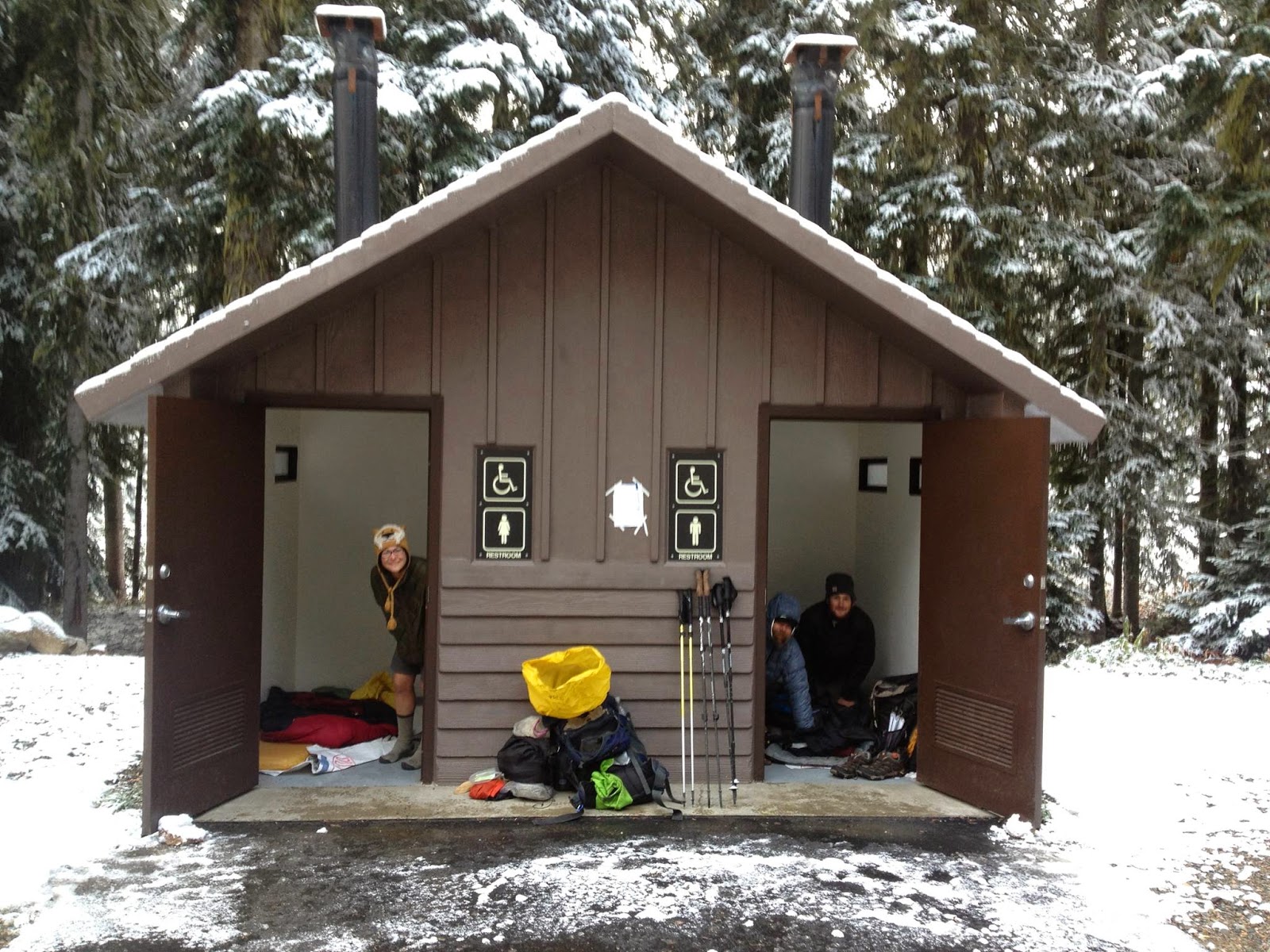
On the other hand, there’s one thing that people will almost definitely never do off trail that, if they hike long enough, is almost inevitable.  I am, of course, talking about sleeping in a bathroom (AKA "The Privy Bivy").

In 2008, the day before my PCT hike began,  Scott “Squatch” Herriott and I were at Mt. Laguna and stopped by the Laguna Mountain Visitor Center.  If you take the path to the right, you end up in the Center, and can get all sorts of information about Cleveland National Forest.  We took the path to the left, and ended up at the bathrooms, which were large, clean, dry, and comfortable.
“This bathroom is amazing,” I said.  “There’s only one problem with it.”
“What’s that?” asked Squatch.
“It’s only 43 miles into the trail.  Almost no one will appreciate how nice it would be to sleep in here.”

Rainy Pass (or possibly Snowy Pass)
That’s a complicated way of saying that for the most part, just like real estate, opening a restaurant, and how far away from me you should be sleeping when I’ve eaten a Mountain House Chili Mac With Beef, sleeping in a bathroom is mostly about location, location, location.  And possibly rain, snow, and cold.


Lose the toss, sleep next to the can.
Typo, Hee Haw, and Scallywag.


Don’t get me wrong -- the things you’d like to see in a bathroom you’re using as a bathroom still apply when you’re using it as a bedroom.  Except things are much more relative.  It would be nice if it were dry, but it’s definitely drier than your shelter if it’s been raining for the past six days and the inside of your tent qualifies as a Federal Wetland.  Warm?  Warm is good.  And the inside of a bathroom is almost certainly warmer than the outside of a bathroom that’s under a foot of snow.  And clean is definitely a positive, but if you’re honest with yourself, you’re already pretty filthy.  If anything, the bathroom should be concerned about you.

Dirty.  But dirtier than you?  Not really, no.
So maybe it’s late in the season and you’re at a place called “Rainy Pass,” and the weather has been teetering back and forth on the line between annoying and alarming.  And maybe “Rainy Pass” is called that for a reason (it is), although “Snowy Pass” would also have been an appropriate choice.  And there’s a bathroom in the trailhead parking lot (ADA compliant, which to a hiker means “plenty of room for sleeping!”).  And like most bathrooms, there might be signs that tell you what you can’t do in there (no smoking, no putting feminine hygiene products in the toilet), but funny enough, none of them ever say “No Sleeping In Here.”  Because who would do that?

You.  You would do that.  

I mean, who would walk from Mexico to Canada?  You’re already doing something that doesn’t make any sense.  Sleeping in a bathroom won’t exactly make you any more weird than you were before you slept in a bathroom.

Hybrid bathroom sleeping.
So now that’s we’ve very generally covered the merits of sheltering in bathrooms and you realize what a fantastic idea it can be, I know what you’re wondering.  “Do you have any tips when selecting this kind of shelter?”

Of course I do.

-- Unlike shopping for a tent, tarp, or hammock, weight is pretty much a non-factor.  I don’t even know how much a bathroom weighs.

-- A skylight is a nice touch, but not absolutely necessary.  The weather is a festival of misery out there.  The sun will, in fact, come out tomorrow -- just not where you are.


Also great for cooking in!
-- Look for hooks and/or nails on your bathroom walls. They’re perfect for hanging up your wet gear and lying to yourself about it drying overnight.

-- Your bathroom is most likely going to be near a road, so the ability to lock it is something to look for.  A passing motorist might want to actually use it as a bathroom.  But who does that?  Isn’t that what the woods are for?

-- an overhanging roof, like a vestibule, is good for storing wet gear, dirty boots, or a hiking partner who has eaten a Mountain House Chili Mac With Beef for dinner.

-- as with fish, and um, let's just go with shoes: size matters!  You really can't get a good night's sleep in a PortaJohn.


Don't try it.  Trust me.
Remember to tip your housekeeper!

You’ll find other things to look for as you gain more experience by spending more time in bathrooms, but those are just the details.  Overall, try to keep this in mind: the charms of thru-hiking are many -- the beauty of the mountains and wild spaces; the restoration of faith in humanity through the kindness of strangers; the ability to destroy two large Meat Lovers Pizzas plus an entire apple pie and not gain weight.

And the ability to sleep absolutely anywhere, including pit toilets.

SOL on the CDT in a bathroom "vestibule."
As I’m going to claim John Muir once said, “Keep close to Nature's heart . . . and break clear away, once in awhile, and climb a mountain, spend a week in the woods, and sleep in a bathroom.  Wash your spirit clean.  And Purell absolutely everything afterwards.” 


John Muir probably didn't say this.


Note: As usual, I write these things, but I don't make them alone.  Special thanks to those who answered my call for help/provided photos: Annie Mac, Hee Haw, Balls, Smooth, Spitfire, Neon, Daredevil, Wired, Skeeter, SOL, Mags, and Squatch.


Sunday, March 30, 2014

Hikers Rescued From The Appalachian Trail In Hanover, NH


Recently there have been a number of rescues on the AT and other trails, and the responses by the hiking community have ranged from, "so happy no one got hurt" to "well, I hope they learned their lesson" to "they BURNED THEIR CLOTHING to stay warm?!?  What the #@&%?!?"

But I think it's important to remember that while getting lost or needing rescue can happen to anyone, the chances of it becoming necessary go up exponentially if you're stupid.  And Search and Rescue will tell you that there are a lot of really stupid people out there.

So by way of cautionary tale, here's a news story from a couple of years ago about a rescue that took place on the Appalachian Trail in New England.  Fortunately, although the hikers involved did sustain severe injuries, there was no loss of life.  So have fun out on the trails, but be careful!


From the AP Newswire: August 28 -- A local SAR unit, 50 search volunteers, and a New Hampshire National Guard Helicopter crew were involved in responding to an emergency beacon, known as a SPOT device, in downtown Hanover, New Hampshire on Thursday.

One of the lost hikers, taken shortly before the incident.
(identity hidden to prevent even more embarrassment)
The hikers were on a section of the Appalachian Trail, which passes through Hanover.  The hikers were initially confused as to where the trail went through town.  "We were on Wheelock Street coming into town, but then the trail seemed to disappear," said one of the hikers, who wished to remain anonymous, "and then we were on this big grassy area.  We hit the SPOT device immediately and decided to set up camp and await rescue.  A few minutes later Steve looked across the street and saw the blazes, so we hit the 'OK' button and kept hiking."

When interviewed in the hospital, the
lost hikers said some confusion stemmed
from the blazes being, "totally on the
wrong side of the street."
The hikers made it part of the way down Main Street before getting in trouble again.  "Neil needed some smokes, and we got completely off trail after a local gave us directions to Stinson's," said one of the hikers, who wished to remain anonymous, "and then we bought some beer and drank it in the parking lot behind the Nugget and by that time it was clear we were completely lost, and possibly idiots."  With daylight fading and the hikers exhausted, disoriented, and pleasantly buzzed, they again activated the SPOT device.


By this time local authorities had already formed search teams based on the first activation of the device, which had never really been cleared.  But the searchers were looking for the lost hikers on the College Green.  "We had fifty or so searchers wandering around up there, because, honestly, doing a grid search on the Green looks kind of silly," said one of the searchers, who wished to remain anonymous.  Said another searcher: "It was pretty clear from the outset that we weren't going to find them, but I did get two girls' phone numbers."
The search area for the lost hikers looked absolutely
nothing like this.

The hikers were eventually spotted by a National Guard helicopter in the parking lot behind the Dartmouth Bookstore.  One of the hikers had suffered a slight ankle injury on the Bagel Basement steps, but they were otherwise unharmed.  "We got really turned around and confused there for a while," said the third hiker in the group, who wished to remain anonymous.  "Ed thought that if we could just figure out where 5 Olde was, then we could have another beer and calm down and try to find Main Street.  But in the state we were in and with no trail to follow, that was pretty much wishful thinking."

The three hikers were air lifted out of the parking lot and taken to the Dartmouth Green, where they were beaten senseless by search volunteers.


Saturday, February 22, 2014

Trail Magic Recipes For Home: Oreo Truffles


My Mom (AKA "Jester's Mom") is known far but possibly not wide as an excellent baker of all sorts of Trail Magic goodies.  The problem: normally, you have to do the work of actually hiking to benefit from this.  And who wants to do that?

Pat O'Donnell, badass baker and hiker
So this will be the first in a series of blog posts that will provide you with the ability to enjoy Trail Magic baked goods from the comfort of your couch, your bed, or even the floor, should your hiking lifestyle put you in the position of not being able to afford furniture.  Or maybe you'll make a batch and drive to the nearest trail to give some out to hikers, only to discover that you've eaten three-quarters of them on the way there.

The beauty of this recipe to me is that it doesn't really involve "baking," which makes it a good recipe for those who are afraid of ovens, those who are too impatient to let one pre-heat the whole way, and those who, if allowed to use an oven, would burn the house to the ground. 

Oreo Truffles
Makes: 4 doz. or 48 servings, 1 truffle each (alternately, if you are alone in the house when you make these, it sometimes makes 1 serving of 48 truffles)

Prep Time: 45 minutes
Total Time: 1 hour 45 minutes

Ingredients:
1 pkg. (8oz) Philadelphia Cream Cheese, softened
1 pkg. (15.5oz) Regular Oreo Cookies, finely crushed (about 4-1/4 cups), divided
2 pkg. (8 squares each) Baker's Semi-Sweet Chocolate

What else you need:
Mixing bowl, mixer, large heatproof bowl, pan/pot for simmering water, wax paper, baking sheet, two forks 

Directions:

1. In a mixing bowl, mix Cream Cheese and 3 cups cookie crumbs until well blended.

2. Shape into 48 (1 inch) balls and place on wax-lined tray.  Refrigerate for 15 minutes.

3. Place broken up chocolate in a large heatproof bowl set over a pan of simmering water; stir until melted and smooth.  Note: bowl should not sit IN the water, but should rest on top of pan/pot.

4. Dip balls in melted chocolate (you’re allowed to giggle softly to yourself at that direction, but let’s not get carried away); place back on waxed paper-covered baking sheet.  Sprinkle with remaining cookie crumbs.

5. Refrigerate one hour or until firm.  Store in tightly covered container in refrigerator.

Tip:
How To Easily Dip Truffles: Add truffles, in batches, to bowl of melted chocolate.  Use 2 forks to roll truffles in chocolate until evenly coated.
Remove truffles with forks, letting excess chocolate drip back into bowl.  Place truffles on sheet.


Friday, February 14, 2014